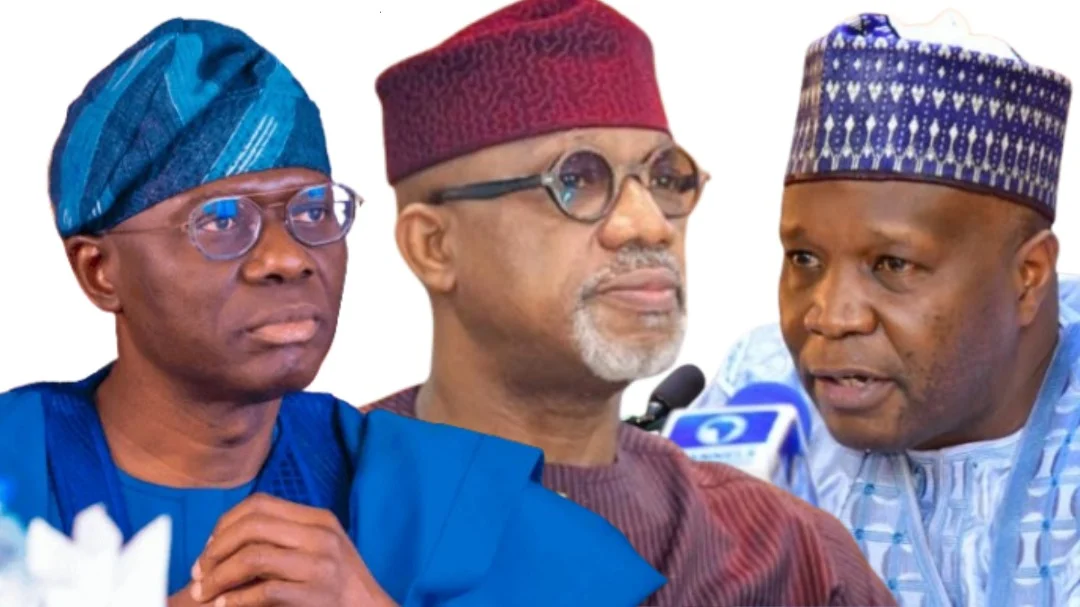
The simmering build-up to the 2027 general elections is rapidly giving way to an expansive and high-stakes succession season in at least 10 states, as governors in their final terms prepare to exit and a new generation of political actors moves to take their place.
Governors Babajide Sanwo-Olu (Lagos), Dapo Abiodun (Ogun), Seyi Makinde (Oyo), Bala Mohammed (Bauchi), Mai Mala Buni (Yobe), Babagana Zulum (Borno), Ahmadu Fintiri (Adamawa), Inuwa Yahaya (Gombe), Abdullahi Sule (Nasarawa), and AbdulRahman AbdulRazaq (Kwara) are in the final lap of their constitutionally permitted two-term, four-year tenures, and the battle for their successors has begun across the states.
From the South-West to the North-East, what is emerging is not a routine transition, but a complex web of ambition, rivalry, and shifting alliances, with dozens of aspirants already positioning across party lines.
In states like Oyo, Nasarawa, Lagos, Bauchi, and beyond, the early contours of these contests reveal a familiar but intensifying mix of factors—zoning disputes, internal party fractures, defections, and the outsized influence of incumbents. Beneath the surface of formal declarations, consultations have deepened, alignments are quietly forming, and the real battles—often within dominant parties—are already underway, long before voters are called to the polls.
In the aforementioned states, the emerging picture is one of crowded fields, fragile party cohesion, and strategic calculations driven by zoning, religion, and incumbency power.
The Independent National Electoral Commission has fixed January 16, 2027, for the presidential and National Assembly elections. Expectedly, some governors whose tenures will end on May 29, 2027, are likely to seek senatorial tickets.
According to the timetable released by the commission, however, their successors will be determined two weeks later, on February 6, 2027.
The strength of political parties, alongside the influence of incumbents, is likely to shape the outcome of the succession contests.
Except in Oyo and Bauchi states, where the ruling Peoples Democratic Party is grappling with internal crises, other states are predominantly controlled by the All Progressives Congress.
With 2027 setting in, early permutations in Lagos suggest that the real contest may not be between political parties, but within the ruling APC.
The continued dominance of the APC under President Bola Tinubu shapes the state’s political trajectory, suggesting that securing the party’s ticket is key to succeeding Sanwo-Olu.
Discussions about who succeeds the incumbent as Lagos governor remain in hushed tones.
Since 1999, the state has been governed by the Tinubu political family. The President had governed the state from 1999-2007, former Governor Babatunde Fashola from 2007-2015, ex-Governor Akinwunmi Ambode from 2015-2019; and the incumbent’s tenure, which began in 2019, is billed to expire on May 29, 2027.
Since 1999, political parties aligned with Tinubu — the Alliance for Democracy, Action Congress, Action Congress of Nigeria, and now the APC — have consistently produced the state’s governor, and 2027 is not expected to be any different.
Efforts by the opposition to dislodge the APC have largely faltered, as only the PDP and Labour Party (in the 2023 presidential election) have made attempts to wrest power from the ruling APC.
The African Democratic Congress, branded as the new opposition, has not been convincing enough about its capability to upstage the APC in Lagos State, even with the influence of its National Secretary and former Osun State Governor, Rauf Aregbesola.
The dwindling fortune of the opposition parties in the country, especially since the 2023 election, will convincingly earn the APC another shot at the governor’s seat.
Only a few opposition members have declared their interest in running in the 2027 election. Gbadebo Rhodes-Vivour, who was the governorship candidate of the LP in the 2023 election, has joined the ADC and has expressed his desire to run again for governorship in 2027.
Similarly, a former House of Representatives candidate, Naheem Balogun, also declared interest.
For the PDP, leading the pack is Funso Doherty, who ran for governorship under the ADC in 2023. There is also a businessman and entrepreneur, Laja Adeoye.
However, these parties presently appear weak ahead of the 2027 elections and would have a lot of ground to cover and hope that the odds are in their favour to win in a state that has been so dominated by the ruling APC.
For the APC, Mr Jide Adediran, popularly called Jandor, and Mr Samuel Ajose, fondly called SMA, have declared their intentions to run on the platform of the party for the 2027 governorship in Lagos State.
Jandor, known for his “Lagos for Lagos” slogan, was the PDP’s governorship candidate in the 2023 election, but defected to the APC to pursue his governorship ambition again.
Ajose continues to boast of the support of the people of Badagry zone, who say, “Badagry lo kan.” He recently organised a rally for the anticipated second term bid of President Tinubu.
Interestingly, both Adediran and Ajose are from the Badagry administrative division of Lagos. While Jandor preaches Lagos for Lagos, SMA preaches Lagos for All.
Beyond the declared aspirants, several influential figures are believed to be quietly consulting. Among those touted as interested in the Lagos governorship is the former governor, Ambode, who the people of Epe demand be allowed to return for another four years, just like his predecessors, who served for eight years.
The Speaker of the House of Assembly, Mudasiru Obasa, also boasts of vast political experience, having been the number one lawmaker in the state since 2015. The people of Agege constituency have declared their desire to rally support for their own should he get the ticket.
Obasa is seen as a strongman of Lagos politics, having been able to return as Speaker after he was removed. While those forces which masterminded his removal remain, some observers note that Obasa’s political prowess may be needed for the APC to record success in the 2027 election.
The current Minister of Education, Dr Tunji Alausa, recently denied declaring for governorship. However, political watchers note that this is not an unusual position for someone eyeing a position and does not want to be portrayed as too desperate, considering that he is presently occupying public office as minister.
Alausa has continued to get closer to home in recent times, as he chaired a recent event of the indigenes of Epe. This, many note, is part of consultations with his own people to boost his chances of being talked about by Lagos stakeholders when a decision on the candidate is to be taken.
The Chief of Staff to the President, Femi Gbajabiamila, has continued to invest in his Surulere constituency as his infrastructural projects litter the constituency. Having also been Speaker of the House of Representatives, Gbajabiamila would also fancy his chances.
The incumbent deputy governor, Obafemi Hamzat, also boasts of experience, having been around government circles for a while and also coming from a family respected in political circles.
Many have also spoken about his loyalty and down-to-earth nature, which also put him up for consideration.
The Chief of Staff to the Governor, Mr Tayo Ayinde, is also being spoken about in political circles as a potential candidate.
Also being touted is the Principal Secretary to the President, Hakeem Muri-Okunola. Okunola has served Tinubu for many years, as he was a personal assistant to the president when he was governor of Lagos State. He is seen as being among the kitchen cabinet of the President.
Also, there is a campaign about the President’s son, Seyi Tinubu, seeking the governorship ticket. But many dismiss Seyi’s ambition, noting that he is only bringing himself into the limelight ahead of subsequent elections after 2027.
There are also chances that the senator representing Lagos East senatorial district, Tokunbo Abiru, may be eyeing the governorship.
Analysts note that many of the potential contenders are technocrats rather than career politicians, a trend consistent with Lagos’ leadership pattern since 1999.
Zoning considerations may not be decisive, as party cohesion has historically overridden regional balancing within the APC.
But, beyond the permutations, the man to decide who gets the Lagos APC governorship ticket is the President. Many party insiders believe the most decisive factor remains Tinubu’s influence.
While the Governor’s Advisory Council and other party stakeholders are expected to play key roles, the President is widely regarded as the dominant voice in determining the party’s candidate.
In Oyo State, the race to succeed Governor Makinde in 2027 is no longer a quiet undercurrent. It is fast becoming a defining political moment, shaped by a crowded field of aspirants, deepening consultations, and a subtle but unmistakable shift in the state’s power equation.
With Makinde set to complete his second term, the question is no longer whether a contest will emerge, but how intense, fragmented, and consequential it will be.
At the centre of this unfolding and intriguing drama is the ruling PDP, which currently holds a structural advantage but faces the burden of managing in-house issues and ambition within its own ranks.
Unlike previous cycles where a clear frontrunner often emerged early, the PDP is witnessing a diffusion of power, with multiple aspirants building influence simultaneously, each representing different strands of the party’s growing identity.
Among them is Dr Nureni Adeniran, whose position as Chairman of the State Universal Basic Education Board has quietly given him one of the widest grassroots “footprints” in the state.
Through the education system, he has cultivated relationships across local governments, positioning himself not just as a technocrat but as a political actor with reach into rural communities.
In contrast, Adebo Ogundoyin represents a different kind of momentum. As Speaker of the state House of Assembly, he sits at the intersection of legislation and executive cooperation, benefiting from proximity to the governor while also projecting generational renewal.
His appeal is strongest among younger political actors and segments of the elite who see him as a bridge between continuity and a new political style. However, questions remain about whether his influence within the legislature can translate into statewide electoral dominance.
The Chief of Staff to the Governor, Segun Ogunwuyi, is being touted in political circles as capable of succeeding Makinde. A former member of the House of Representatives, Ogunwuyi, is believed to be representing the Ogbomoso Project 2027.
For his supporters, though he has not declared his intention, they believe his candidature would strengthen the outgoing administration and improve on its successes.
There is also Dr Debo Akande, who holds several positions in the Makinde government. He is Executive Adviser on Agribusiness to the Governor; Director General, Oyo State Agribusiness Development Agency; and Executive Adviser, International Cooperation and Development. He has mostly been instrumental in driving international partnerships and collaborations for the state, especially relating to agribusiness.
He is usually the right-hand man whenever the governor embarks on foreign trips or hosts international investors, both at home and abroad.
Another emerging actor is a former commissioner for finance during the late Governor Abiola Ajimobi’s second term, Bimbo Adekanmbi. A technocrat he is, but he’s gaining momentum from his Ona Ara Local Government Area base since joining the PDP earlier this year. He was the chairman of the committee that worked on the upgrade of Ibadan airport to an international status.
The re-emergence of Taofeek Arapaja adds another layer of complexity. A former deputy governor and a seasoned party strategist, Arapaja brings institutional memory and national-level connections into the race.
His strength lies in his deep roots within the PDP’s traditional structure, particularly among older party stakeholders who value loyalty and long-term commitment.
However, in a contest increasingly influenced by visibility and populist engagement, his challenge will be to reconnect with a broader electorate beyond the party’s core base.
Also, Adedeji Olajide, currently representing Ibadan North-West/Ibadan South-West Federal Constituency in the 10th Assembly. He has declared his intention to contest the governorship election under the PDP, with a commitment to succeed Makinde and build on his achievements for greater development across the state.
Equally significant is the quiet but persistent presence of Femi Babalola, whose influence may not always dominate headlines but remains embedded within the party’s internal machinery. His long-standing involvement in party affairs positions him as a consensus builder, though whether that translates into frontline candidacy or kingmaker status remains to be seen.
Alongside him, figures like Olufemi Ajadi, who has previously tested the electoral waters in Ogun State before relocating to Oyo last year, and Beulah Adeoye reflect a widening field that blends political experience with fresh ambition.
Insiders within the party acknowledge, albeit cautiously, that consultations around succession have intensified, with aspirants engaging key stakeholders, local government leaders, and influential blocs in what is shaping up to be a carefully managed but highly competitive internal process.
The PDP is, however, facing the uphill task as the party is struggling with an internal crisis, being led on one hand by Makinde and Governor Bala Mohammed of Bauchi and on the other hand by the Minister of the Federal Capital Territory, Nyesom Wike.
A faction loyal to Wike in the state is being led by another former deputy governor, Gbolarumi Hazeem.
The opposition All Progressives Congress in Oyo State faces the dilemma of harnessing its array of aspirants into a coherent, united front.
The party enters the 2027 conversation with renewed energy, although the “unresolved” internal tensions that have historically undermined its chances in the state remain.
At the forefront is the Minister of Power, Adebayo Adelabu, whose current role at the federal level has significantly elevated his profile. His previous governorship bid and technocratic background position him as a candidate capable of bridging policy expertise with political ambition.
The last week of March will, however, determine if he is still interested in the race, with a March 31, 2026, deadline to resign from office to pursue political ambition as directed by the President.
Also of equal influence in the state is Teslim Folarin, the party’s 2023 governorship candidate. Folarin’s strength lies in his longstanding networks and electoral experience, but his repeated bids raise questions about whether the party will once again rally behind him or seek a fresh face to rebrand its appeal.
Beyond the two heavyweights, the APC field is remarkably expansive. Figures like the senator representing Oyo South, Sharafadeen Ali and his Oyo North counterpart, Abdulfatai Buhari, are equally eyeing the governorship.
Buhari, a member of the eighth, ninth and 10th Senate, is reportedly not seeking another term in the Senate, to allow the Oke Ogun bloc to occupy the seat.
Equally interested is the member of the House of Representatives representing Ido Federal Constituency, Remi Oseni. The presence of former deputy governor, Rauf Olaniyan, alongside established political actors such as Akeem Agbaje, Adebayo Shittu, Azeez Adeduntan, Saheed Oladele, and Gbenga Adegbola, highlights the party’s depth.
Also, Kunle Busari, the son of the late Ibadan strong politician in the First and Second Republic, Chief Busari Adelakun, popularly called Eruobodo, declared his ambition for the governorship race under the APC
He made the declaration at Methodist Primary School, Oke-Adu, Agodi-Gate in Ibadan North Local Government Area of the state, on Thursday.
The 2027 race is also witnessing the rise of unconventional actors. Figures like Adegboyega Taofeek of the ADC are drawing on grassroots and traditional networks, while the proprietor of Agidigbo FM, Oriyomi Hamzat of Accord, leveraging his media influence, represents a new form of political capital rooted in public visibility and direct audience connection.
In Oyo, however, there are major issues over who succeeds Makinde. The incumbent is of the Ibadan bloc and a Christian. There is the agitation to have a Muslim to succeed him, while the Oke Ogun, Ogbomoso and Ibarapa zones are positioning to occupy the Agodi Government House.
-All Rights Reserved-
Permission to use any material, including text, still photograph, audio and video from this site is granted subject to permission being formally sought and, if granted, appropriate credit must duly be given to The News Room as the source.
 Stay connected, get exclusive updates, and be the first to know about all the exciting things happening. Whether you’re looking for insights, tips, or just want to be part of an amazing community, our WhatsApp group is the place to be!
👉 Don’t miss out. Click the link and be part of something awesome! 🚀
Stay connected, get exclusive updates, and be the first to know about all the exciting things happening. Whether you’re looking for insights, tips, or just want to be part of an amazing community, our WhatsApp group is the place to be!
👉 Don’t miss out. Click the link and be part of something awesome! 🚀